Showing posts with label Renault. Show all posts

Saturday, October 29, 2011

2011 Formula 1: Indian GP Qualifying Results


This weekend, India hosts its first-ever Formula 1 Grand Prix at the newly constructed, 5.1 km (3.17-mile) long Buddh track in New Delhi. Along with being a big event for the country it also marks a new record for this year’s world champion.

The unstoppable Sebastian Vettel scored his 13th pole position this year, matching Ayrton Senna and Alain Prost for most poles in a season. He needs just one more to equal Nigel Mansell’s 1992 record of 14 poles, while his team has already set its own record in F1 with is 16th pole position in a season.

Read more »

Monday, October 24, 2011

Carlos Ghosn Says 2012 will be a Record Sales Year, Bets Heavily on EVs


Renault-Nissan CEO Carlos Ghosn is upbeat about the way the automotive industry is heading, despite the fact that the economic crisis that threatens Europe is far from over.

In fact, during the recent launch of the electric versions of theRenault Fluence and Kangoo in Portugal last Friday, Ghosn predicted that 2012 will be a record year for car sales worldwide surpassing 2011's volumes.

Read more »

Monday, October 17, 2011

Formula 1: Korean Grand Prix Race Results


With the drivers’ title already decided, the only question before the red lights went off to signal the start of the Korean Grand Prix was whether Red Bull would manage to snag the constructors’ championship as well or if McLaren, the only team with a shot at the title, could keep its (admittedly slim) chances alive for yet another race. Read more »

Saturday, October 15, 2011

Formula 1: Korean Grand Prix Qualifying Results


Well, it was bound to happen at some point: Sebastian Vettel lost the pole position to another driver at the Korean Grand Prix qualifier. For the first time after five races, Vettel won’t be starting Sunday’s F1 GP from the first place on the grid. Read more »

Tuesday, October 11, 2011

Video: Thoughtless Renault Driver Slams into Parked Firetruck


Does someone really have to tell you to slow down when there's an accident on the road? Well, apparently for some drivers, the answer to that question is yes.

And this despite the fact that in this particular incident, which took place in the Netherlands, there are ambulances on the side of the road, a car burning up in flames and a bright red fire truck parked in the middle of the highway. Like, how can you possibly miss it?

Yet a driver of a first-generation Renault Twingo thoughtlessly pushed the pedal to the metal and tried to overtake a line of cars from the middle lane. Video follows below.

Read more »

Monday, October 10, 2011

Vettel Wins Back-to-Back Formula 1 Titles, Lauda says “He Can Surpass Schumacher”


If you have two Formula 1 world championships under your belt by the age of 24, then you surely must be special. Sebastian Vettel, who last year became the youngest world champion ever in the history of the sport, didn’t have anything to prove .

Nor did anyone doubt after the first races of the season, that the 2011 driver’s title would be his. Mathematically, at least, only McLaren's Jenson Button had a –very long- shot at stealing the title after Singapore. At last Sunday’s race in Suzuka, he did his best: Button crossed the finish line first.

Read more »

Thursday, October 6, 2011

Renault to Increase Output of its Brazilian Factories by 100,000 Units in 2013


Brazil is currently Renault’s third biggest market, behind only France and Germany. This year, the French company sold 133,158 Renault passenger cars and 30,672 Renault and Nissan LCVs and, according to the company’s CEO, Carlos Ghosn, along with Russia and India, it's “one of its three top priority markets”.

Ghosn visited Renault’s Curitiba plant and announced the group’s plan to invest €200 million (US$267 million) and add 1,000 jobs in order to increase its production by 100,000 units until 2013.

Read more »

Friday, September 30, 2011

Color me Matte: New Renault Clio RS 200 “Ange & Démon” Edition to be Produced in…666 Units


Renault is playing the good versus evil card with its new limited run Clio Renaultsport 200 “Ange & Démon”, which is French for Angels and Demons. Deviously, the bespoke version of the Clio RS will be produced in a…fiendish 666 units worldwide - as most of you already know, that's the number of the Beast in the Book of Revelation.

Buyers can choose among three different matte shades, including Toro Red, Givre Nacré and Hologramme Grey, all of which feature a gloss black finish for the roof, upper tailgate, rear spoiler, rear diffuser, F1-style blade in the front bumper, the door handles and exterior door mirrors.

Read more »

Tuesday, September 13, 2011

Renault Twingo

New Renault Twingo is the first vehicle in the range to feature the brand's new design identity. The car will go on sale in early 2012, and includes a number of styling features that were unveiled on the most recent concept cars, and which will become the visual signature of all Renault cars in the future.
Outside, the front end of New Twingo has taken its inspiration specifically from this new design approach. On the bonnet, the Renault diamond is both bigger and significantly more upright. The black background highlights the badge and presents the brand in a robust, confident manner. Like the first-generation Renault Twingo, the newcomer features an expressive, appealing front end. Its dynamic, playful character is underlined by its fog lights and round sidelights which are now positioned next to the grille. The 'eyelids' of the headlights also contribute to new Renault Twingo's distinctive looks.


Warm, original new colours called Fuchsia and Bermuda Blue have been added to the existing range, and bring a touch of light-hearted fun that's characteristic of city cars. Depending on market, New Twingo can be fitted with a electrically-operated fabric sunroof as an option.
At the rear, there are new lights in addition to the main cluster. Located on the tailgate, they enhance New Renault Twingo's lines and echo the front end, bringing extra shape and punch to the car. With a rounder rear bumper and a more curved form for the lower part of the tailgate, the lines are softer. Among the 24 different alloy wheel and wheel trim options, one particularly assertive new wheel design (black diamond effect) contributes to improved aerodynamics and reduced CO2 emissions.

Monday, September 12, 2011

Yamaha FZ8

One motor is included in the list of special edition models 50 years of Yamaha in world championship motorcycle racing (Grand Prix) is a Yamaha FZ8. Streetfighter-style motor sport will be getting new clothes as worn motor Jorge Lorenzo and Ben Spies in action in the MotoGP championship at Laguna Seca and Assen series.

So what about the specs of this bike? Let us telisik deeper. Starting from the framework. FZ8 is supported with a full aluminum chassis made​​. To increase the effectiveness of the rear suspension, Yamaha uses CF aluminum material. Although the weight of the motor is lighter, yet able to provide stability even at high speed dilaju.


Looks forward and aft FZ8 emit aggressiveness, it is realized through the design with taper angles on the cover headlights and taillights and body models. Large tank of this bike makes the display look more muscular.

Affairs kitchen runway, Yamaha do not doubt the quality of performance. FZ8 carries the 4-cylinder inline engine with a capacity of 779 cc water-cooled. This machine is capable of spraying power claims of 106.2 PS at 10,000 rpm rotation and a maximum torque of 82.0 Nm at 8.000 rpm range. Exhaust emissions released through the exhaust with catalytic converter is also low because it has been standard Euro3.

Great power and mighty posture should be supported yahud suspension to be comfortable when driving. Sector shock front upright and upside-down 43mm shock Monocross behind to conquer the vibrations or shocks when crossing bumpy road. In addition the suspension is designed as possible in order to work properly when bulldoze sharp turns.


What about the braking system? YZ8 has strengthened diameter 310mm dual discs are clamped by four-piston monoblock brake calipers are placed at the front. While a single 267mm rear discs with single piston calipers from Nissin.

Sunday, September 11, 2011

Renault Present mode in India

NEW DELHI - French carmaker, Renault, again spread its wings in the world of the automotive world. This time, Renault brought new cars, Renault mode to the automotive market in India.

As reported by Motorbeam, Thursday (9/11/2011), Renault will be marketed in the modes other than India, will also make his debut in the event the India Auto Expo 2012. And will begin shipping to India in January 2012.


Renault mode is marketed in India, will be available in two versions, namely the mode and Grand Modes. Both versions are equally present as the car Vechile Multi Purpose (MPV) or better known as the family car.

Mode has a height 1586 mm and 4034 mm in length, although most small MPV car classified but the facility and its superiority is not inferior to other MPV cars in India.


Furthermore, this mode will add to the Renault car-shaped kind of tiny MPV in India. And regarding the price Renault modes are marketed in India is priced at Rs 4.5 lakhs to Rs.6.5 for the type of gasoline and diesel type.

Wednesday, September 7, 2011

Hyundai i40 Tourer UK Version

All-new Hyundai i40 Tourer will be available with a choice of highly competitive Euro V-compliant engines: two petrol and one diesel unit with two outputs. These units include the spreading power output 115 to 177PS. All engines are tuned for strong torque delivery is extended in a variety of machine-wide operating speed, making the i40 car fun to drive in town or on the highway. Manual and automatic transmission will also be offered.

In the segment where the diesel models representing 77% of total sales, Hyundai anticipates that the version of ‘higher power’ of the 1.7-liter diesel unit developing 136PS engine will be the most popular among both private and fleet buyers. High-output engine torque (325 Nm from 2,000 rpm) will ensure the drive responsive to the acceleration to 62mph in just 10.6 seconds for the manual model and fast 12.0 seconds with automatic.
Version of the ‘low power’ produces 115PS which takes from 0-62mph in 12.9 seconds. The petrol engine is Hyundai’s all new four-cylinder 2.0-liter GDI engine, called ‘Nu’. This all-aluminum engine makes its debut on the i40, promises to deliver higher torque (for enhanced drivability), improving fuel economy and reduce emissions, plus reduced NVH characteristics of durability and very good – similar to the machine multi-point fuel injected.


Equipped with a GDI (gasoline direct injection) unit produces 177PS 1999 cc engine which ensures that the i40 Tourer offers the best in class fuel economy. I40 with a manual gearbox and the engine will accelerate to 62mph in just 9.7 seconds to register figures fuel economy 39.2mpg (combined cycle) and reached the rank of CO2 is only 169 g / km. 1.6-liter petrol engine offers a proven 16-valve Gamma Unit. It produces 135PS and accelerating from 0-62mph in 11.6 seconds.

Monday, August 22, 2011

VolksWagen up

Volkswagen has redrawn the map of the small car world. The goal: to develop a small car with charisma, a small car with maximum space on a minimal footprint, a small car with the most fuel-efficient engines or an electric drive, a small car with intuitive infotainment and operating systems, a small car with the safety of a large car. The result is the new Volkswagen up! It measures a short 3.54 metres and is a specialist for everyday urban living that was thought through to the last detail. This car - like the larger Polo and the even larger Golf - will appeal to people of all ages and mobility wishes.

Affordable for everyone. In launching the up!, Volkswagen is not only putting a new car in motion; it is also redefining the parameters of customisation and financing. This means that along with clearly delineated equipment lines on the Volkswagen up!, new features will be offered such as up! boxes - e.g. box sets for shopping, long trips or for children on board. The up! will have an infotainment system that owners can tailor to their personal profiles using apps. And because a small car needs to be affordable, a new financing model known as AutoCredit2 that is exclusively tailored to VW up! buyers will offer greater financial freedom thanks to its flexible configuration options. And for many people, this will make the goal of driving a safe and economical new car more attainable than ever. Like the Beetle back in the 1950s, one could say that the Volkswagen up! is once again "democratising" car driving.
The up! will first be launched in the European market. It all starts in December 2011. There are 3 versions for different budgets and needs: take up! is the entry-level car, move up! the comfort-oriented one and high up! the top version. Directly at the car's market launch, there will also be 2 independent models based on the high up!: the up! black and the up! white.

New generation of engines
Debuting in the Volkswagen up! is a new generation of three-cylinder petrol engines. They output 44 kW / 60 PS and 55 kW / 75 PS. Combined fuel consumption as a BlueMotion Technology version (including a Stop/Start system): 4.2 l/100 km (60 PS) and 4.3 l/100 km (75 PS). Both of these 1.0-litre engines emit less than the 100 g/km CO2 limit. A natural gas engine with 50 kW / 68 PS with the same basic configuration will follow. Its combined fuel consumption of 3.2 kg/100 km (natural gas) is equivalent to a CO2 value of 86 g/km; as a BlueMotion Technology version the natural-gas powered up! even attains a low CO2 value of 79 g/km. There are also definite plans for an up! with an electric drive for the year 2013.
First small car with City Emergency Braking
An important new safety technology system is the optional City Emergency Braking. It is automatically active at speeds under 30 km/h, and it uses a laser sensor to detect the risk of an imminent collision. Depending on the vehicle's speed and the driving situation, City Emergency Braking can reduce accident severity by initiating automatic brake interventions - and possibly even avoid a crash. So far, the VW up! is the only vehicle in the segment to be offered with an emergency braking function for city driving.
Dimensions and styling for the world's metropolitan areas
With its noted 3.54 metre length and 1.64 metre width, the Volkswagen up! is one of the smallest four-seat cars. The Volkswagen is 1.48 metres tall. Its overall length consists of conspicuously short body overhangs and a very long wheelbase (2.42 metres) - a body layout that fully utilises the space available in the new design. Klaus Bischoff, Head of Design for the Volkswagen Brand says: "If the goal is to maximise space, the ideal form for a small car would be a rectangular box. In the up! we were able to sculpt such a box with a clean and powerful design that does not lose sight of space utilisation." The front end of the VW up! reveals much about the car's character. Klaus Bischoff: "The face is unmistakably that of a genuine Volkswagen, but with a very independent personality. Naturally, the familiar styling characteristics of our brand face can also be found on the up! - the emphasis of horizontal elements and the connection of the grille and headlights to form a band, the accents created by small angles and the characteristic light signature of the headlights. But more than on any of the other models, the Volkswagen up! definitely shows a smile. The up! is simply appealing, and it appeals in a simple way!"
Uncompromisingly good use of interior space
Space utilisation in the car is exceptionally good, because of its wheelbase - one of the longest in the segment - combined with an engine that is mounted well forward. Although the driver, front passenger and 2 rear passengers are travelling in a small car, it is by no means a cramped vehicle. On the contrary. Consider the boot: 251 litres are significantly more than is typical in the vehicle class of the up! When the rear seat is fully folded, cargo space even increases to 951 litres. These two values show that in its interior the Volkswagen up! will be a giant among small cars.
An interior design that is fun
Essentially, the up! interior has a very clean and well-organised layout. The new Volkswagen also offers numerous clever and detailed solutions, fun styling and a level of quality that will enhance the market segment. Especially high-end is the Dash Pad, an instrument pad extending crosswise in front of the driver and front passenger. Depending on the equipment line, either decor paint or one of the 5 body colours is used in the interior.
VW up! boxes - small things that make a big difference
The developers of the Volkswagen up! asked themselves whether everyday living with the car could be structured in a simpler and friendlier way. Their answer was a decisive yes! Because it is often the small things that make a big difference. And that is how the idea of the up! boxes came about. Small, lightweight boxes for a wide variety of situations and needs. Take the "kid box", for example, that was designed for parents with small children; it includes a bag for the thousand small items that are essential with small children; and of course a toy to cuddle with and a lunch box for the obligatory snacks. Other Volkswagen up! boxes will be called the "city box" and the "travel box". And their names are their agendas.
maps + more - the Portable Infotainment Device (PID)
For the first time in a Volkswagen, the maps + more system is now being offered, a mobile Portable Infotainment Device (PID). In the economically priced up!, this is a system that is equally economical and was developed to organise the navigation, telephone, information and entertainment areas. In cooperation with Navigon, one of the world's leading suppliers of navigation systems, a special solution was tailored to the up! which is affordable for all buyers - maps + more. The user simply snaps the PID into place above the centre console. Unlike many other similar systems of this type, maps + more melds with the car's network of systems much better: navigation, telephone and infotainment can now be controlled and viewed via the PID touchscreen, and the touchscreen can also be used to view important vehicle information, such as the visual display of the ParkPilot (controls the car's distance to the next vehicle). Apps specially developed for the VW up! also let users extend maps + more to meet their specific needs.

Friday, August 19, 2011

Pagani Zonda F

The Pagani Zonda is a supercar made by Italian car maker Pagani. It debuted in 1999 and continues through the present, with production proceeding at roughly 25 cars per year. As of December, 2005, 60 Zondas had been built. It is a mid-engined 2-seat coupe and convertible. Construction is mainly of carbon fiber.
Some early Zonda engineering was done by Formula One champion, Juan Manuel Fangio. The car was originally to be named for him, the "Fangio F1", but the name was changed upon his death in 1995.
The Zonda is often compared to other supercars such as the Enzo Ferrari, the Koenigsegg CCR, the Lamborghini Murcielago and the Porsche Carrera GT.
1999 Zonda C12

The C12 debuted at the 1999 Geneva Motor Show. It was powered by a 6.0 L (5987 cc) Mercedes-Benz M120 V12 engine and could reach speeds of 185 mph (297 km/h). The engine produces 408 PS (300 kW/402 hp) at 5200 rpm and 421 ft·lbf (571 N·m) at 3800 rpm.
Just five of the original 6.0 L Zondas were built, though it was still available in 2002 when the C12 S debuted. One was used for crash testing, while another was a demonstrator and show car. The rest were delivered to customers over the next three years, priced at US$320,000.
The C12 could accelerate to 60 mph (97 km/h) in 4.2 seconds and hit 100 mph (161 km/h) in 8.2 seconds. Acceleration through the quarter mile was 12.1 seconds at 124 mph (200 km/h). Lateral acceleration on the skidpad was .93g, and the car could brake from 60 mph (97 km/h) in 110 ft (34 m).
1999 Zonda C12 S
The C12 S used a 7.0 L (7010 cc) AMG tuned version of the engine producing 550 PS (404 kW/543 hp). It can accelerate to 60 mph (97 km/h) in 3.7 s, to 100 mph in 9.5 s and complete the quarter mile in 11.9 s. Lateral acceleration on the skidpad is 0.98 g (9.6 m/s2). The car is 10 kg (22 lb) lighter than the normal Zonda C12. Top speed is 220 mph (354 km/h) for the coupe and 215 mph (346 km/h) for the roadster. The car's price tag was US$350,000.
The C12 S features an elongated nose and flaps at the rear for improved aerodynamics. New light clusters and exhausts are also used. Fifteen 7.0 L C12 S cars were produced.
2002 Zonda C12 S 7.3
The 7.3 L (7291 cc) C12 S 7.3 of 2002 used one of the largest V12 engines ever made. The engine was designed and manufactued by Mercedes-Benz AMG. Traction control was added to handle the 555 PS (408 kW/547 hp) and 750 N·m (553 ft·lbf) that this engine produces. As of 2005, only five coupes out of an expected 100 have been produced.
A roadster version is also built, with production limited by the company to 40 examples. As of 2005, nine roadsters had been built. According to Road & Track magazine, three more C12 S 7.3 cars had been built as of June, 2005, but it is unclear whether they were roadsters or coupes. Motor Trend reported that 60 Zondas of all types had been built in their January 2006 issue.
2003 Zonda GR
Development of the Zonda GR started in December, 2002. At this stage the Zonda was nearly four years old, but had yet to be entered in major motorsports. Tom Weickardt, owner of American Viperacing, Toine Hezemans, owner of Carsport Holland, and Paul Kumpen, owner of GLPK, created a new company, Carsport Zonda, to build a racing version. They secured exclusive rights to develop, build and sell competition Zondas from Horacio Pagani, and the first GR was completed at Carsport's facility in Modena within months.
The Zonda GR is based on the Zonda C12 S. It was built on the same carbon fiber chassis, with tube frames in front and back. The bodywork was modified to include front and rear diffusers and louvers for improved aerodynamics. The car was 2 m (6.6 ft) wide, in accordance with the regulations of the FIA and ACO. The car's weight was reduced to 1100 kg (2425 lb), and a new suspension was designed. New wheels and brakes were also specified. The engine was equipped with an enlarged radiator, and the engine and gearbox also have new oil coolers.
The performance of the Zonda GR is well beyond that of the stock car. The car sprints from 0 to 60 mph (97 km/h) in 3.3 seconds and the engine produces around 600 PS (around 440 kW) at 5800 rpm and 580 ft·lbf (786 N·m) of torque at 4300 rpm with a redline increased to 7500 rpm. The added power and improved aerodynamics allow the car to hit 215 mph (346 km/h).
C12 S Monza
The Zonda C12 S Monza debuted at the 2004 Paris Motor Show as a track-day version of the Zonda for private use. Borrowing its appearance cues from the Zonda GR, the Monza included many features which could also be applied to other Zonda models. A dry sump engine tuned to more than 600 PS (more than 440 kW) was used, and the cooling was improved. Modified aerodynamics, including a different wing and front diffuser, allowed greater speed, as did optimized gearing. The car was lighter, with polycarbonate side windows, and an unmuffled exhaust is fitted. The revised interior includes different pedals, steering wheel, and seats, as well as a reinforced roll cage. Larger brakes and a stiffer suspension also improve performance. Finally, an external fire extinguisher is included for safety.
2005 Zonda F (C12 F)
The Zonda C12 F debuted at the 2005 Geneva Motor Show. It is the most extensive reengineering of the Pagani car yet, though it shares much with its predecessors including the 7.3 L V12. Power is increased to 602 PS (443 kW/594 hp) with a special clubsport model producing 650 PS (478 kW/641 hp). The company promises a 3.2 second sprint to 60 mph (97 km/h, a top speed over 350 km/h (218 mph) and it will be the queen in braking from 300 km/h to 0 (186 mph to 0). The Zonda F clubsport has a power to weight ratio of 521 bhp/ton (384 W/kg) . Compare, for example, the Enzo Ferrari which has a power to weight ratio of 483 bhp/ton (356 W/kg).
Production of the Zonda F will be limited to 25 cars, still not US compatible. The next model, due to be unveiled in 2008, will be fully EPA/DOT compatible.
The Zonda F, named after F1 pilot Juan Manuel Fangio, comes with an extra head light and different fog lights at the sides, new bodywork (revised front end, new rear spoiler, more aerodynamic vents all around) that improves the cars aerodynamics and different side mirrors. Further enhancements over the 'S' centre around optional carbon/ceramic brakes developed in conjuction with Brembo, magnesium wheels, inconel titanium exhaust system, hydroformed aluminium intake plenum and a redesigned 'Z preg' weave in the crash structure to improve rigidity and reduce weight.
Zonda Roadster F
The Zonda Roadster F debuted at the 2006 Geneva show. It is similar to the coupe, but with a removable carbon fibre roof and canvas side curtains weighing just 11 lb (5 kg). Production of the Roadster F is suggested at 25 units.
The Roadster F is able to maintain chassis rigidity without any gain in curb weight by eschewing conventional thinking by not strengthening the sills - a process which would have needed more than 35kg of reinforcement. Pagani instead uses racecar thinking, materials and construction techniques, strengthening the firewall structure of the chassis tub together with billet alloy braces that connect the points where the roof rails would have joined. The windscreen is also strengthened for safety reasons. These techniques enable the Roadster to have virtually the same weight as the coupe - 1230kg.

Friday, August 12, 2011

2012 Ford Focus Studio

The new Ford Focus Studio extends the all-new Ford Focus range to five series, with prices from £13,995 for the Focus Studio to £24,000 the top-of-the-range Titanium X with six-speed Powershift automatic transmission and 163PS TDCi engine.
This newcomer replaces the popular Ford Focus Sport, a final special edition of the previous model which has been on sale since October 2010 and reached sales of 15,000.

Nigel Sharp, Ford of Britain managing director, said: “With the high end of the new Focus range fully established, we are now making it easier for customers to get behind the wheel at the entry level – and this new Ford Focus Studio model is not only affordable but it is also well equipped, attractive and economical too.”
Standard equipment on the all-new Ford Focus Studio includes 16in sports-style alloy wheels, body-coloured rear spoiler, radio/CD player, USB connectivity, air-conditioning, electrically-operated body-coloured door mirrors with integrated turn indicators, electrically-operated front windows, Ford Easy Fuel ‘capless’ refuelling, and Electronic Stability Programme (ESP) with torque vectoring control.


The Ford Focus Studio will be offered as a five-door hatchback with 85PS 1.6 Ti-VCT powertrain, delivering a fuel efficient 47.9mpg. There will be three colour choices – Panther Black, Moondust Silver and Frozen White.

Wednesday, August 10, 2011

Hyundai Genesis 2012

The Hyundai Genesis sedan is designed to offer the luxury appointments of much more expensive cars, for less.
The Genesis can be had with a 333-hp 3.8-liter V6, a 385-hp (using premium fuel) 4.6-liter V8, or a 429-hp 5.0-liter V8. All engines send power to the rear wheels through an eight-speed automatic transmission that features manual sequential shift capability. Mechanical safety features include traction control, stability control, and panic brake assist. The interior features a full compliment of airbags, electronic active front headrests that provide whiplash protection, and a tire pressure monitor. Luxurious leather seats, automatic dual-zone climate control and woodgrain trim are just some of the appointments this car offers that are typically only found in vehicles costing much more.

The Genesis receives several notable changes for 2012. The 3.8-liter gains gasoline direct injection (GDI) which ups the horsepower to 333. A new 5.0-liter R-Spec model with 429-hp has been added to the line-up. The 4.6 and 5.0 gain heated rear seats, puddle lamps, power folding exterior mirrors and lane departure warning for 2012.

2012 Chevrolet Sonic

Chevrolet displayed the all-new 2012 Sonic at the 2011 North American International Auto Show. Its youthful, aggressive design is backed by turbocharged performance and agile ride and handling, combining to deliver an efficient, fun-to-drive small car.
The Chevrolet Sonic is offered in two body styles: a stylish four-door sedan and a sporty five-door. Each delivers class-leading rear-seat roominess and cargo space. A variety of connectivity features enhance the driving experience.

"The all-new Chevrolet Sonic blends the practicality of a small car with the passion for driving that Chevrolet vehicles like the Corvette are known for," said Chris Perry, vice president of Chevrolet marketing. "Its combination of great design, fun driving experience and the latest connectivity features create a serious competitor with a fun spirit."
Production of the Chevrolet Sonic begins later in 2011 at the General Motors Orion Assembly Center in Michigan, which received a $545-million investment in upgrades and retooling, and will help restore approximately 1,000 jobs in the metropolitan Detroit area.

"Chevrolet is the only company building a small car in the United States," said Perry. "We believe the Sonic will bring substance to the segment, with progressive styling, performance and value that will change perceptions of what a small car can be in America."

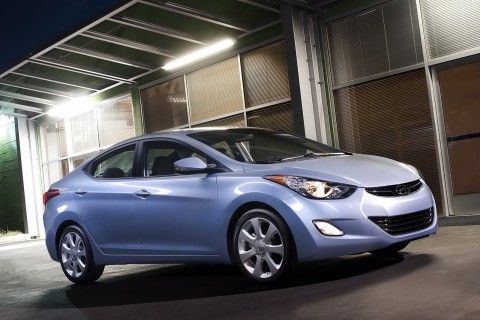
2012 Hyundai Elantra

The Hyundai Elantra is a compact car with handsome styling and nice lines. It has excellent interior space and standard safety equipment.
The current generation Elantra can seat up to five and has very accommodating trunk space. Two trim levels are offered: GLS and Limited. Both use a 148-hp, 1.8-liter four-cylinder engine. A six-speed manual transmission is standard on the GLS trim, while a six-speed automatic with Shifttronic is standard on the Limited trim and available on the GLS. Standard safety features include four-wheel anti-lock disc brakes, electronic stability

control with traction control and six airbags. Available features include a power sunroof, turn signal indicators on exterior mirrors, 17-inch aluminum wheels, heated leather seating surfaces and Bluetooth.
The 2012 Elantra carries over from 2011.


Hyundai Veloster

Perhaps the biggest question surrounding the Veloster is its unique three-door arrangement. This isn't the first time we've seen extra doors on sport coupes, but Hyundai has chosen to forego the use of rear-hinged suicide doors for an honest-to-goodness full-size door on the passenger side of the Veloster. To maintain the car's coupe-like style, the rear door handle has been integrated into the C-pillar, and you really have to see it in person to understand that it's not nearly as awkward as you might think.


Hyundai promises that the Veloster will be agile and fun to drive, employing things like a lightweight V-torsion beam in the rear suspension setup, a 23-millimeter stabilizer bar to control body roll and sport-tuned electric power steering. A quick-ratio steering system has also been fitted, and the Veloster rides on standard 17-inch wheels wrapped in 215/45-series all-season tires. Two sets of 18-inch alloy wheels are available, housed in 215/40-series performance rubber.
The Veloster is powered by Hyundai's all-new 1.6-liter Gamma inline-four which produces 138 horsepower at 6,300 rpm and 123 pound-feet of torque at 4,850 rpm. No, it isn't a particularly potent engines, but it should be plenty to move the 2,584-pound Veloster along at a decent clip. Through the use of direct injection, Hyundai is able to make this mill surprisingly efficient, and while official EPA numbers haven't been released just yet, Hyundai claims that the Veloster will net around 40 miles per gallon on the highway, easily besting the Honda CR-Z hybrid and even smaller B-segment offerings like the Mazda2 or Honda Fit. The standard transmission is a six-speed manual, though an all-new six-speed dual-cluch transmission is available.


Inside, Hyundai provides a host of newfangled technology, including a standard multi-function seven-inch touch-screen display with Pandora internet radio, Gracenote music display, video playback, video game console connectivity (yes, you read correctly – video game console connectivity) and, of course, Bluetooth. How's that for trying to capture the youth market? Of course, Hyundai's usual host of safety equipment is still on deck, with the new Blue Link telematics system that encompasses things like automatic crash notification, enhanced roadside assistance, remote door and vehicle start, and convenience features like voice text messaging, vehicle diagnostics information and a range of navigation features.

Pricing has yet to be announced for the 2012 Veloster, but in keeping with Hyundai's quest for affordability, we'd assume that the starting price for the new sports coupe will be found somewhere in the sub-$20,000 range. 

Monday, August 8, 2011

Brabus Mercedes-Benz SLK-Class

A sporty designer suit, custom-tailored wheels with diameters of up to 20 inches complete with corresponding suspension options, performance tuning for all engines and exclusive interior design: Brabus now offers an extensive customization program for the new Mercedes SLK.
Sporty-elegant Brabus aerodynamic-enhancement components give the roadster an even more thrilling appearance. The two Brabus front spoiler lips that attach on the left and right side of the production apron and the striking bezels for the daytime running lights lend the SLK a more striking nose. But that's not all: the spoilers also reduce lift on the front axle which particularly benefits directional stability at high speeds.

The Brabus side sill attachments emphasize the sporty lateral lines of the car and seem to make the rear fenders wider visually. The rear of the car receives some added sporty character with the Brabus diffuser and the Brabus rear spoiler on the trunk lid. The diffuser is integrated with utmost precision into the production bumper and features a centrally mounted rear reflector. These aerodynamic-enhancement components also serve more than just a visual function; they reduce lift in the rear as well.
A major contribution to the sporty appearance of the new SLK from Bottrop likewise comes from the Brabus Monoblock wheels, which are available in various one-piece or multi-piece designs with diameters ranging from 17 to 20 inches.
The attached photos show the roadster equipped with Brabus Monoblock F wheels painted the new exclusive 'Liquid Titanium' color. They are mounted in size 8.5Jx20 in front and in size 9.5Jx20 on the rear axle. Brabus recommends high-performance tires from Continental, Pirelli or Yokohams in sizes 235/30 ZR 20 on the front axle and 275/25 ZR 20 in back.
Brabus sport springs were custom-developed to match the conversion to these king-sized tires. They are calibrated to work with the production shocks, and lower the ride height of the two-seater by some 30 millimeters (1.2 inches). Brabus also offers various versions of its high-performance brake systems for the new SLK.
These measures furthermore make the new SLK perfectly suited for some extra power. In a first step Brabus offers efficient and reasonably priced Brabus ECO PowerXtra CGI tuning for the four-cylinder direct-injection engines. The processor-controlled Brabus ECO PowerXtra CGI auxiliary control modules are custom-tailored to each respective engine variant and can be installed by any authorized Mercedes-Benz dealer in less than an hour thanks to their 'plug and play' design. All performance kits are backed by the one-of-a-kind Brabus Tuning Warranty® of three years, up to 100,000 kilometers / 62,000 miles (updated November 2006). Brabus recommends Aral high-performance lubricants.
To retain the engine's longevity and fatigue strength these kits are designed to only activate the performance-enhancing mapping when all parameters such as engine temperature etc. are in the green. This effectively prevents the performance increase from negatively affecting the service life of the engine.
After the installation of the Brabus ECO PowerXtra B20 CGI performance kit the four-cylinder direct-injection engine of the SLK 200 BlueEFFICIENCY produces an extra 26 hp (25 bhp) / 19 kW of power and an additional 30 Nm (22 lb-ft) of peak torque.

The new SLK 250 BlueEFFICIENCY can be upgraded at Brabus in two stages. The Brabus ECO PowerXtra B25 CGI module bumps power output of the four-cylinder direct-injection engine from standard 204 hp (201 bhp) / 150 kW to 230 hp (226 bhp) / 169 kW at just 5,500 rpm.
Another ten additional horsepower can be realized with the supplementary installation of a larger intercooler and an electronically controlled Brabus sport wastegate valve that are part of the Brabus ECO PowerXtra B25S CGI performance kit. 240 hp (236 bhp) / 176 kW of power and 370 Nm (273 lb-ft) of torque in overboost mode accelerate the two-seater in 6.2 seconds from rest to 100 km/h on the way to a top speed of 248 km/h (154 mph).
On the road all CGI engines performance-tuned by Brabus deliver not just excellent driving performance but also optimized pulling power from low engine speeds and favorable fuel economy. Just as important for the Brabus engine specialists were exemplary low emissions: like the corresponding non-tuned engines all engines with Brabus ECO PowerXtra CGI performance kit meet strict Euro V emission limits.
The installation of the Brabus stainless-steel sport exhaust system is advantageous not only for tuned engines. Its four tailpipes featuring the typical Brabus design not only give the roadster an even more exclusive appearance but also produce an even sportier exhaust note for all engine variants.
Another focus of the Brabus refinement of the new Mercedes SLK is the interior. Brabus offers an extensive program for the roadster: it includes attractive accessories such as high-gloss polished stainless-steel scuff plates with Brabus logo and sporty elements such as aluminum foot pedals and shifter.
Requests for even more individuality can be fulfilled by the Brabus upholstery shop in the form of exclusive interiors crafted from especially soft and breathable Brabus Mastik leather and Alcantara.