Showing posts with label Opel. Show all posts

Thursday, October 20, 2011

Opel Zafira Tourer

Offering a perfect blend of functionality and comfort, the new Opel Zafira Tourer transports the Insignia values to the monocab segment - premium qualities, innovative technologies, sculptural and dynamic design. Opel established the seven-seat compact van segment in 1999. With an extensively re-designed Flex7 seating system, the new Zafira Tourer now sets novel standards in interior flexibility and atmosphere.
But the third-generation Zafira's innovations go well beyond this newly developed, flexible seating configuration. The Opel Zafira Tourer as a whole demonstrates a big step forward and expresses new ambitions. It is the ideal flexible companion, not only for families. Its elegant design, spacious lounge atmosphere, upgraded chassis and new technologies enable relaxed driving with maximum comfort and safety. The second generation of the Opel Eye front camera builds the basis for a range of innovative assistance systems, and Opel is the first automaker to offer a compact van with adaptive, radar-based speed control.
The engine range on offer for the new Opel Zafira Tourer will initially consist of highly efficient diesel and gasoline engines with output from 81 kW/110 hp to 121 kW/165 hp. Shortly after the start of sales, an especially low-consumption ecoFLEX model with a 2.0 CDTI common-rail turbo diesel and standard Start/Stop technology will join the Zafira Tourer family. The Zafira Tourer 2.0 CDTI ecoFLEX, boasts one of the values in the compact monocab class with just 119 g/km CO2. And this comes with spirited performance of 96 kW/130 hp and maximum torque of 300 Newton meters.


First impressions count: Sporty and dynamic look

The new Opel Zafira Tourer makes a very powerful first impression. The new sculptural design language has improved the already functional and highly successful predecessor of the Zafira Tourer and resulted in an even more refined product with premium qualities. Every detail in the cabin interior has been carefully considered. The Zafira Tourer successfully combines practical thinking with a passion for cars. The values of agility and comfort which are embodied in the highly successful Insignia have been transferred to the Opel Zafira Tourer. This has taken the new vehicle to the next level.
Futuristic and dynamic chassis design
The Opel Zafira Tourer's distinctive front is defined by bold boomerang graphics in the lighting units that sweep from the headlights to the fog lamps. All the lighting functions are joined up in a smooth and seamless fashion. The trapeze-shaped grille and the distinctive crease in the bonnet, consistently applied to the Opel brand, have created a very dynamic and progressive look. Further typical Opel design cues include the wing-shaped daytime running lights in the front and rear.
The driver's field of vision has been greatly improved because of a new set of slender "hydroformed" A-pillars and relatively sleek B-pillars in the interior, plus generous side windows at the front. Visibility has also been significantly boosted with the rear view mirrors on both sides. The mirrors come in a two-tone combination: a shiny black gloss on top, so as to be harmonious with side-glass and the color of the car's body. This makes them appear smaller than they really are. The overall premium quality look is further boosted by the Insignia door system, known for its "door frames under glass". All the exterior panels have been aerodynamically and acoustically designed to reduce noise levels.
The silhouette of the Opel Zafira Tourer takes its design cues from the aerodynamic and streamlined shape of a high speed train. The blades on the flanks of the car create a powerful forward motion. The sporty look is reinforced by crisp and sweeping lines. The appearance of the monocab is further enhanced with a smooth line that runs from the front of the roof to the roof spoiler. So the car appears to lie lower. The Zafira Tourer looks very muscular in the optional OPC style which is available for the Edition (EU: Enjoy), Sport and Innovation (EU: Cosmo) variants. The front spoiler, rear lower skirt, side skirt and enlarged roof spoiler give the monocab a sporty feel.
The slender rear lights, again with wing shaped taillight functions, can be fitted with LED technology if required. The horizontal chrome bar between the lamps has the Opel emblem prominently placed and is broad and distinctive. It gives the vehicle a sporty but refined look. The fog lights have been fitted into the bumper at the rear, enabling the rear lights to look more slender.
Cinematic feel with panoramic windscreen and sun roof
The interior of the car has a cinematic feel and is flooded with light because of the generous panorama windscreen. What started out as an optional extra in the 2006 Astra GTC, has now also been made available on request for the new Opel Zafira Tourer. Driver and passengers can with the optional extra enjoy the airy feel of the cabin and the generous views to the outside, thanks to the layout of the glass that stretches all the way to the back of the front row. In addition, there is a sunroof that stretches all the way to the rear of the vehicle. This boosts the airy lounge atmosphere throughout the interior.
Stylish elegance enhances feel good factor
High quality fabrics on the inside help to create a lounge feel. The new Flex7 plus seating system is further improved with the innovative FlexRail center console. A leather gear shift and steering wheel help to create an atmosphere of stylish elegance and sportiness. These features are all standard in the Edition (EU: Enjoy), Sport and Innovations (EU: Cosmo) variants. These models are also equipped with black instrument panels with highly polished chrome rings. In the Sport and Innovation (EU: Cosmo) models there is additional translucent backlighting. Furthermore, the Innovation variant comes complete with the central FlexRail console. All variants contain a subtle red ambient lighting, giving the cabin interior a comforting glow when it is dark. Great ergonomic positioning of center stack controls make this a well-organized and relaxing place to spend time.
Thirty storage spaces
After detailed customer surveys and marketing analysis, the Opel design team went about making big advances in terms of storage space. The cabin of the new Zafira Tourer remains very tidy and well organized because of a better distribution of seating space and thirty new storage places.
A very high degree of functionality, flexibility and pleasant atmosphere combined with top quality fittings all contribute to the unique feeling inside the cabin.
The roominess is further boosted with its generous loading capacity of the Zafira Tourer
The five-seater configuration provides 710 liters of storage space - 65 liters more than its predecessor. The maximum storage capacity is 1.860 liters (40 liters added) and can be achieved by folding the three single seats in the second row.
You can find further details on flexibility solutions in the chapter on "Flexibility", including the Flex7Plus seating system, the added storage space and the panorama windscreen.
Sets New Flexibility Standards
Innovative, flexible, high-quality and ergonomic: With the further developed Flex7 seating system as well as a host of other Opel-typical Flex features, the Opel Zafira Tourer defines new standards in interior versatility and atmosphere.
Already back in 1999, Opel established the seven-seat compact monocab segment with the first generation of the Zafira. With what is now the third generation, Opel is set to continue the success story. The principle is the same today as it was then: maximum on-board flexibility without seat removal. Offering a perfect blend of functionality and wellness, the new Opel Zafira Tourer brings Insignia values to a compact monocab - premium qualities, innovative technologies and sculptural, dynamic design.

Together with the Meriva, the European number one in small monocabs, the Zafira Tourer makes Opel the benchmark in terms of flexibility. While the second-generation Meriva introduced in 2010 offers unrivalled flexibility in a smaller format particularly for young families, the new Zafira Tourer combines even higher versatility with additional premium qualities in interior comfort and atmosphere. This makes it the ideal choice for families with older children or for business people - such as photographers or architects - who also have to transport bulky objects for their work. All this is easier than ever with the new Opel Zafira Tourer.
Versatility: Individual seats in rear for maximum flexibility and comfort
Just like in the first two Zafira generations, maximum flexibility with numerous interior configurations without seat removal is the Zafira Tourer's underlying principle; it also impresses with its airy, light and high-quality interior. In addition, Opel engineers have substantially upgraded the clever Flex7 seating concept.
While both third row seats can still be folded down flush with the floor of the luggage compartment like in the predecessor generations, Opel engineers have completely re-designed the second row. No longer a bench, it now consists of three individual seats that can slide longitudinally by 210 mm (100 mm forwards, 110 mm backwards) independently of each other and can be folded flat, thus creating an even load floor. In addition, the backs of the three seats can be reclined in four different positions (0, 16, 20 and 24 degrees).
All Opel Flex features have to meet Opel's key requirement of optimum handling: Thanks to the easy-to-reach loop handles that are colored for better differentiation (red to fold down and black to pull upright), the seat backs can be completely folded down in one simple movement for a maximum of versatility without having to remove seats or headrests.
Lounge seating system: Second-row passengers enjoy first-class feeling
The highlight of the new Opel Zafira Tourer is the Lounge Seating system that provides second-row passengers generous seating space like in an upper-class sedan. This new interior configuration is standard for the top equipment variant Cosmo and optional for the Enjoy.
At the push of a button, the three seats in the second row transform into two exceptionally comfortable seats with lots of extra legroom and shoulder space: the outer seats slide up to 280 mm backwards - best-in-class value, and 70 mm more than in the standard version - and then slide 50 mm towards the center of the cabin, a true novelty in the segment.
Then a clever and easy-to-operate folding/rotating mechanism transforms the back of the middle seat into comfortable armrests for the passengers in the outer seats. Opel has filed for a patent for this system, which is unique in the industry.
In this two-seat configuration in the rear, the Zafira Tourer offers first-class comfort and gives the special feeling of travelling in a "lounge on wheels". Second-row passengers enjoy maximum space and comfort as well as a highly ergonomic seating experience.
This emphasis on personal wellness makes the Zafira Tourer much more than just a family vehicle. Opel designers turned the flexible interior into a place to relax and enjoy the spacious atmosphere - be it on a business trip or a journey with family or friends.
Innovative front seats: Top comfort and ergonomics
The front cockpit is clearly arranged and offers driver and passenger highest comfort. The completely re-designed front with slim A-pillars, large side windows and side rear-view mirrors mounted on the doors greatly improve the driver's visibility.
The Opel Zafira Tourer also comes standard with innovative, large and anatomically designed front seats, which can be configured in a number of ways and are equipped with active head restraints. The front seats developed by Opel engineers offer comfort unique in the segment and a best-in-class adjustment range. Both seats can slide back 180 mm, and the height of the driver's seat can also be adjusted up to 65 mm higher. Also a special form of flexibility: Both driver and front passenger seats provide occupants of every body type, shape and size the optimum position - especially very tall drivers, who often complain about limited space in vehicles in the compact segment.
The ergonomic seats are optionally available for driver and front seat passenger, so both can benefit from the tilt-adjustable seat cushion, adjustable lumbar support, and extendable seat cushion. The seats feature the coveted seal of approval from Aktion Gesunder Rücken e.V (Action for Healthy Backs), an independent association of doctors and back experts. Requisite for granting the AGR certificate is that the contours of the seat back exactly adapt to the natural curvature of the spine - a seat characteristic that makes a positive difference on both long and short journeys.
A front passenger seat variant that can be folded down to transport longer objects is available as an option. The stable, foldable and space-saving luggage compartment cover FlexCover that can be stored in the rear builds an even load floor and protects the backs of the seats from dirt. The two outer second-row seats have ISOFIX mountings and top tether eyelets for child safety seats.
FlexRail: Innovative storage system for center console
The flexible center console FlexRail (standard in Cosmo variant and optional with Enjoy) was further enhanced compared to the system available in the Meriva. It is constructed as a modular storage system on three levels:
  • Two rails made from high-quality polished aluminum run between the front seats. The FlexRail modules slide back and forth on them.
  • The upper rail carries a generous armrest that opens to offer two storage compartments, for example for CDs.
  • Underneath is another compartment with two cup holders.
  • On the lowest level is another, deep storage container where personal items can be stored out of sight, covered by the armrest and cupholders. Due to its proximity to the AUX and USB ports as well as the 12-volt socket, it is the perfect place to keep an MP3 player or a portable navigation device safely hidden from public view.
Especially practical is that all FlexRail elements can be removed, either separately or together, e.g. for cleaning. The new system is another example of the high levels of flexibility in the Opel Zafira Tourer - easy to reach and in exactly the right place. FlexRail comes in combination with the space-saving electric parking brake.
FlexRail and the storage pockets in the front doors are indirectly illuminated by red light beams (ambient lighting). So in addition to improving visibility in the dark, a cozy atmosphere is also created.
Perfectly positioned: Over 30 storage spaces exactly where needed
FlexRail is a perfect example of how Opel ergonomic experts use the results of market research and customer surveys to develop an interior that is highly progressive in terms of functionality. As all items normally carried on board have their own, easily accessible space, the interior remains tidy and organized.
In the new Zafira Tourer, this is ensured by a system with more than 30 storage compartments. 1.5-liter beverage bottles can be stored safely and upright in the pockets on the front doors, and those on the back doors can hold 1.0-liter bottles. In another storage space above that, there is room for a cell phone. Passengers in the third row also have practical storage spaces on the sides as well as a console with two cup holders between the seats.
There are two large glove compartments in the instrument panel on the front passenger side. Both have a lid to keep the contents from public view. The lower glove compartment also has an extra space for the car manual and holders for coins and pens. An open storage space between the two glove boxes has a rubber lining to prevent items placed there from sliding around.
The center console in the cockpit features further practical storage areas: a compartment with lid in front of the central display and an open, deep space directly under the 12-volt socket, USB and AUX ports that are beneath the infotainment/climate controls.
On the driver's side there is a compact, pull-out storage box that is ideal for small items such as sunglasses, wallets and cell phones. In addition, storage boxes under the driver and front passenger seats are available as an option.
Roomy luggage compartment: Up to 1,860 liters volume, clever FlexOrganizer Pack
In the five-seat configuration, the Opel Zafira Tourer provides 710 liter of luggage compartment volume, 65 liters more than the current Zafira. The maximum load volume of 1,860 liters (plus 40 liters) is available when the three seats in the second row are folded down.
A tidy load area is a snap with Opel's FlexOrganizer Pack, which consists of a luggage net with two rods, another smaller luggage net, four adapters and rails mounted on the sides of the trunk. The system comprising transport and storage elements enables customers to partition the load area as they wish for specific purposes. Four lashing eyes make securing goods safe and easy. The luggage compartment cover fits perfectly into a recess behind the third row, where it can be stored when not in use.
New generation of FlexFix bicycle carrier system: Now up to four bikes
It generally requires great effort to expand the transport capabilities of a car. Not so with the Zafira Tourer. The second generation of Opel's exclusive, fully-integrated FlexFix bicycle carrier system that premieres in the new Zafira Tourer is now even easier to use and offers further functionality.
Familiar from the previous FlexFix carrier system, the second generation is also ready to use in seconds and disappears almost invisibly into the rear bumper when not in use. As with all Opel Flex features, easy handling without special tools was the priority.
The new FlexFix system - that now also appears for the first time in the Astra Sports Tourer - is, just like the predecessor version, designed for the transport of two bicycles. These two bicycles now can weigh up to 30 kg each (20 kg before). A further novelty is an adaptor available as an accessory that now enables the transport of two additional bicycles weighing up to 20 kg each.
FlexFix is designed to carry a total weight of 100 kg, so that the more and more popular e-bikes can also be transported. Thanks to the FlexFix bicycle carrier system's low height, bikes can be mounted on its rails easily and without much effort. The new carrier bracket has rubber inserts on its fixing clips for stable mounting of each bicycle frame. The bikes can now also locked to the carrier.
Another novelty: It is now also possible to tilt the loaded bicycle carrier - which is now lockable - to such an angle that the tailgate can be opened, making the Opel Zafira Tourer luggage compartment accessible from outside.
Panorama windscreen and sunroof: Flexible, natural big screen for all occupants
Another highlight of the new Zafira Tourer is the softly domed panorama windscreen, which floods the interior with light. This Opel-patented, innovative option made its premiere in a series-production Astra GTC in 2006 and is now also available for Opel´s new monocab.
The panorama sunroof paired with this, flows directly out of the long, sweeping windscreen and extends all the way to the back of the vehicle, intensifying the effect and offering especially rear seat passengers a pleasant, airy atmosphere.
The panorama windscreen that stretches seamlessly from the back of the hood to far over the front passengers' heads has special glazing that offers a totally new sense of space, visibility and driving experience on both sunny and overcast days. In contrast to conventional windshields/glass roofs, there is no cross-member to spoil the view, so "pilot" and "co-pilot" as well as "passengers" in the rear can enjoy an unobstructed view like out of the cockpit of a jet plane. An easy-to-operate shading system transforms the natural big screen into a normal cockpit, thus enabling flexible perspective changes according to passengers' whim.
Both the panorama windscreen and panorama sunroof are fitted with a special heat-absorbing foil. A power shade system under the panorama sunroof blocks strong sun rays and keeps the interior pleasant and comfortable. The dark tinted Solar Protect heat-absorbing glazing on the rear side windows also prevents the interior from getting too warm.
Ideal mix of comfort and dynamic vehicle handling
The Zafira Tourer, the master of flexibility in the Opel product range, boasts a chassis that offers drivers and passengers a high degree of agility and safety. ABS and ESP are standard features across all models. The front-axle assembly comes complete with an isolated auxiliary frame and McPherson suspension struts which takes its cue from the Insignia. The rear-axle assembly with its Watt's link has been taken from the Astra model and especially adapted to the needs of the Zafira Tourer. The end result for the Opel Zafira Tourer and the wider monocab segment is a unique and relaxing driving experience, giving it the feel of a "lounge on wheels".
In addition, the new Zafira Tourer has been fitted with a significantly longer wheelbase and a wider wheel track. This enhances both the driving experience and the stability of the vehicle. The wheel base has been increased by 57 millimeters and now totals 2.760 mm. The wheel track has gained 96 mm at the front and now stands at 1.584 mm. Meanwhile, at the rear it has grown by an extra 78 mm and now stands at 1.588 mm.
Front axle boosts handling and comfort
The front-axle which stems from the Insignia was especially adapted for the Opel Zafira Tourer.
The upper sides of the McPherson struts are double-acting bearings so that the forces acting upon the springs and shock absorbers are thus separated. The unsprung masses are reduced and the weight distribution is improved with steering swivels, A-frame and comfort sleeve being aluminum. The frontal stabilizer is made from hollow profile steel.
The transverse link which is shaped like an L is connected to the front auxiliary frame with the help of two sleeves. This ensures maximum stability. The suspension geometry and the sleeves are fitted together in such a way that they are stiff in the horizontal position but elastic in the vertical direction. This juxtaposition provides more stability and better handling and overall comfort. In addition, hydraulic shock absorbers which sit behind the sleeve of the transverse link provide a high level of comfort. Vibrations from the chassis are blocked out in this manner.
Light, compact and efficient: rear axle with Watt's link
The Zafira Tourer has been given a specially adapted combination of the twist-beam rear axle and the Watt's link for the rear axle. Such a mix has already been proven in the Astra model. The precision of steering and the vehicle's stability in bends are significantly improved from the unique combination of lateral rigidity and camber stiffness. The level of comfort and rate of shock absorption are also improved by the reduction of friction inside the suspension as well as greater elasticity in the forward direction.
The Watt's link sits immediately behind the central axle on the floor of the vehicle and consists of a movable compensation steering unit and a ball-and-socket joint that is attached to the cross struts with the wheels. The Watt's link absorbs the cornering forces that arise in bends and redistributes them onto the small axle unit on the floor of the vehicle. This system stops any sideways movements of the axle. The compensation steering absorbs and transfers around 80 percent of the horizontal forces which bear down on the rear wheels.
A further advantage is that the bearings of the main axle are subjected to less force. This means that the liners of the bearings are made softer. In turn, disruptive external factors, for example from the surface of the road, are blocked out. This leads to less noise in the vehicle interior.
Another bonus of the new rear axle system in the Zafira Tourer is the FlexFix bicycle carrier. The FlexFix allows the Zafira Tourer to transport up to four bikes at a time and a load of up to 100 kilograms.
FlexRide chassis improves safety and handling
The mechatronic and electric bumper system which are part of the FlexRide chassis are a further feature to ensure crisp and precise vehicle handling. The chassis automatically adapts to road conditions, speed, motion and the individual driving style of the person behind the wheel. A high degree of stability plus a responsive steering unit, deliver more balance and safety in potential emergency situations.
Cenors fitted to the body of the vehicle feed information to the Driving Mode Control (DMC) unit which in turn adjusts the chassis according to the current conditions. FlexRide possesses three different modes: the default setting for daily use, the "Tour" setting to ensure extra comfort and the "Sport" mode for more dynamic driving.
The standard mode is a good all-rounder. The "Sport" setting on the other hand delivers a crisper sensation. The engine, the chassis and the steering are all more responsive. The same can be said of the automatic transmission and the AFL-Plus lighting system. The "Tour" mode meanwhile is designed to deliver a smooth, almost glide-like sensation on the road.
Electronic power steering boosts efficiency
The newly developed Rack Assist Electric Power Steering (REPS) delivers a more dynamic driving sensation. At lower speeds the power steering has an easy touch and at higher speeds ensures close contact with the road by reducing the degree of power steering.
A substantial advantage of the REPS system lies in its potential to cut fuel consumption and thus to reduce CO2 emissions. The electronic power steering only kicks in when it is needed so that there is no need for a hydraulic pump.
InnovativeTechnologies For Maximized Comfort and Safety
With its upgraded chassis featuring a longer wheelbase and wider tracks, the new Opel Zafira Tourer provides outstanding comfort and safety reserves. These can be further enhanced by the fully adaptive mechatronic FlexRide chassis control and an array of class-leading driver assistance systems based on several kinds of sensoring technologies - such as cameras, radar and ultrasonic sensors. A special highlight is the Zafira Tourer´s radar based Adaptive Cruise Control - a premiere in the compact monocab segment.
The first and foremost technological enabler of Opel Zafira Tourer's premium comfort and safety is the more powerful, second generation of the "Opel Eye" front camera system. As the result of two years of further development, it is now much more compact - with a volume reduction of 35 per cent that benefits the driver's visibility - and provides with an improved image processing thanks to its widened lens' view and a more powerful multitasking high-performance computer. This benefits to the accuracy of the Lane Departure Warning (LDW), increases the capabilities of the Traffic Sign Recognition (TSR) and now allows to enhance the functionalities of the Opel Adaptive Light System (AFL+) with a new Intelligent Light Ranging (ILR) capability.
A radar sensor can be combined to the front camera system. This innovation in the Zafira Tourer is also a premiere in the compact monocab segment. The highlight - unique in the compact monocab segment - is the radar based Adaptive Cruise Control that maintains the selected speed during cruising, yet automatically adjusts the vehicle speed according to traffic conditions to secure a pre-set safety distance with vehicles ahead.
Further functionalities - all new in the Opel portfolio - are available in conjunction with the Adaptive Cruise Control: The Following Distance Indication (FDI) that visually informs the driver about the distance to the car ahead; the Forward Collision Alert (FCA) that provides a visual and an audible signal to warn the driver of an imminent collision with the car ahead; and the Collision Imminent Braking (CIB) that automatically decelerates the vehicle if the risk of a collision is detected. In cars without radar, FDI and FCA functionalities are also available with the front camera only.
In addition to the radar sensor located in its front end, the new Opel Zafira Tourer is also equipped with multiple ultrasonic sensors allowing to maximize safety and comfort with further new, innovative technology features such as the Side Blind Spot Alert (SBSA) that warns the driver of a potential imminent collision when changing lanes, and the Advanced Park Assist (APA) that automatically detects suitable parking slots and guides the driver in parking maneuvers.
Last but not least, a new rear-view camera system further facilitates parking maneuvers.
Engines and Transmission
Ready for its sales debut in the fall, the new Zafira Tourer is being offered as an optimized 2.0 CDTI Common-Rail Turbodiesel in three performance categories: 81kW/110hp, 96kW/130hp and finally as 121kW/165hp at the top of the range. The Opel Zafira Tourer, the new Master of Versatility, is furthermore available with two highly-efficient 1.4 liter gasoline turbo engines, of between 88kW/120hp and 103kW/140hp. They are in line with Opel's engine downsizing strategy. The portfolio is rounded off with the 1.8 liter basic gasoline engine of 85kW/115hp.
Shortly after the sales premiere, Opel will also offer an ecoFLEX version with especially low CO2 emissions. Equipped with the Start/Stop system and further ecoFLEX technologies, the new Opel Zafira Tourer 2.0 CDTI 130hp version emits just 119 g/km CO2, with a fuel consumption of 4.5 liters over 100 kilometers. This makes it one of the lowest-emission and most efficient compact monocabs engines ever.
At the start of 2012, the Zafira Tourer Compressed Natural Gas (CNG) 1.6 liter Turbo ecoFLEX will be released with a performance of 110kW/150hp. During the fall of next year, a Liquified Petroleum Gas (LPG) engine of 103kW/140hp will be added and then other powerful engines will be released later on in 2012.
Diesel engines balance power with efficiency
Just like its other siblings in the ecoFLEX portfolio, the new third generation Zafira Tourer ecoFLEX engines lay to rest the old prejudices that low emissions figures mean low performance. The 2.0 CDTI, 81kW/110hp engine only consume 5.2 liters of diesel per 100 km (137g/km CO2,). It generates speeds of up to 183 km/h and delivers 0-100 km/h in just 12.5 seconds. The 96kW/130hp version with the same efficiency figures (fuel consumption and CO2) reaches a top speed of 191 km/h. It can achieve 0-100 km/h in 11.4 seconds. The top of the range diesel engine, the 121kW/165hp version fitted with the Start/Stop system as standard, boasts a top speed of 208km/h, while it can deliver 0-100 km/h in just 9.8 seconds. These figures demonstrate the engine's power and agility. The emission and consumption figures remain the same as above, with 5.2 liters of diesel and 137 g/km CO2.
The new Zafira Tourer diesel engines are impressive for their elasticity. The 96kW/130hp unit can deliver 300 Nm of torque at between 1,750 - 2,500 rpm. However, the 121/165hp engine can perform an extra 50 Nm. When it operates in the automatic Overboost mode, it can even reach 380 Nm. Meanwhile, the 81kW/110hp version reaches 260 Nm.
The highly efficient diesel engines and optimised six-gear transmissions have also helped to deliver efficiency and powerful performance at the same time. The 1.4 liter turbo gasoline engine with its 103kW/140hp and the 2.0 CDTI engine with 121kW/165hp are also available with an automatic six-gear transmission complete with Active Select-Function.
Multi-layered efficiency package
Thanks to the engine optimisation by Opel's engineers, the 2.0 CDTI Common-Rail Turbo Diesel run with the highest efficiency in any condition. The new multiple injection system delivering up to 1,600 bar of pressure, improves the combustion process and reduces fuel consumption. To reduce friction in the engine, the bearings of the two camshafts have been improved and cylinder pressure sensors in the glow plugs (Cleantech Combustion Technology) enable very accurate combustion control.
A bypass drilling into the oil cooler helps to reduce the loss of pressure during the warm-up phase of the engine. This in turn helps to accelerate the warm up period. Additionally, a optimized platinum surfacing of the main and secondary catalyst, plus a tight fit of the components help to speed up the warming up process. The positioning of the emission control system near the engine also helps to reach the operating temperature quicker. At the same time low voltage spark plugs assist the electric generator during a cold start.
In the 121kW/165hp version engine, a new turbo charger equipped with a variable turbine geometry, regulates the charging pressure with the help of setting element censors. In the 2.0 CDTI (96kW/130hp) version a variable displacement oil pump delivers only the necessary oil pressure.
While efficiency is increased, there is a reduction of vibrations and noise. This is mainly due to a new injection strategy. Especially in the partial load category, for example in heavy traffic, the 2.0 CDTI engine operates in a smoother fashion. An improved kinematic between the piston and the connection rod reduce the mechanical and combustion noises of the 2.0 CDTI engine unit.
Gasoline efficiency: the 1.4 liter Turbo ecoFLEX engine
The new 1.4 turbo ecoFLEX gasoline engine plays a key role in the Opel Zafira Tourer. The state-of-the-art unit delivers 88kW/120hp or 103 kW/140 hp. Using Start/Stop technology, it only consumes 6.3 liters per 100 kilometers and emits 148g/km CO2 Just like its diesel siblings, this charged four-cylinder engine boasts a brand new electronic combustion control. A pair of twin overhead camshafts that have variable openings are the driving force behind the four valves per cylinder. The variable opening and closing moments increase the torque at lower to medium rotation speeds. Another important fuel saving measure is the map controlled thermostat which optimizes the heat management of the engine unit.
The reworked transmission has been given a wider gear ratio. This has reduced fuel consumption but has increased agility. When in the over boost mode, the 1.4 turbo engine gained an extra 20 Nm (220 Nm in total), making it more powerful than its Insignia counterpart. This means the 140hp Zafira Tourer with Start/Stop system is able to cover 0-100 km/h in 10.7 seconds. It reaches a top speed of 202 km/h.
CNG and LPG: Attractive alternatives
Opel wants to offer its customers alternatives to conventional fuel sources. CNG (Compressed Natural Gas) and LPG (Liquefied Petroleum Gas) variants are available and are cost-efficient, environmentally-sound alternatives. Only 129g/km CO2 emissions are attributed to the 1.6 CNG turbo ecoFLEX engine with 110kW/150hp, which is being brought to market at the start of next year. The 103kW/140hp LPG-variant will follow in the fall of 2012.
All CNG and LPG models by Opel fulfill the Euro-5 norm. They work in conjunction with natural gas and gasoline so that their operative radius is greater than a purely gas operated engine.
The 1.6 liter four cylinder CNG turbo ecoFLEX contains special piston, valves and valve seat rings as well as a separate injection systems for natural gas and gasoline. The engine management was optimized for the CNG version. The inlet, discharge valves and valve seats have all been hardened for the LPG models to fully maximize the performance of the engine. Additional additives which normally compensate for the lacking fluidity of the alternative power source are redundant.
Opel's generous after-sales servicing program is available to CNG and LPG customers. The Opel subsidiary, the Opel Special Vehicle GmbH (OSV), is responsible for the new CNG and LPG variants of the Opel Zafira Tourer. Customers can therefore be confident that they are buying into state-of-the art technology
Master of Versatility: Zafira Tourer ecoFLEX only with 119g/km CO2
Opel will also offer an especially low CO2 ecoFLEX version of the seven-seat monocab. Equipped with Start/Stop as a standard feature and a comprehensive package of ecoFLEX technologies, the new Opel Zafira Tourer 2.0 CDTI ecoFLEX consumes only 4.5 liters of diesel per 100 kilometers, while emitting just 119 g/km CO2. The figures are some best in the compact monocab segment. These results are achieved at an engine performance of 96 kW/130hp engine at a maximum torque of 300 Nm.
Like its other ecoFLEX siblings, the 96kW/130hp version of the 2.0 CDTI shows that low emissions and consumption states do not impact negatively on the engine performance. The top speed is 193 km/h, while the vehicle can accelerate from 0-100 km/h in just 11.4 seconds.
Comprehensive package to cut consumption and emissions
On top of the improvements to the 2.0 CDTI engine and the longer spacing in the transmission, the new Opel Zafira Tourer 2.0 CDTI has also had a whole range of improvements done to its body in order to cut consumption. For improved aerodynamics, the body is 10 mm lower and an active aero shutter is integrated in the radiator grille. While it remains open to maintain optimal temperature at low speeds and when the engine is running under high thermal load such as on inclines and when in towing mode, the aero shutter automatically closes at higher speeds and directs driving wind around the car. This results in improved aerodynamics, lower fuel consumption and lower CO2 emissions. The Zafira Tourer 2.0 CDTI ecoFLEX has 225/50 R17 low-rolling-resistance tires. The shift indicator - an illuminated gauge located between the speedometer and revolution counter - signals the driver the ideal moment to shift up and helps to adapt to a fuel-saving driving style.
Intelligent: Energy recuperation in engine overrun mode
To ensure optimum electrical energy management, Opel has introduced a braking energy recuperation system which recovers kinetic energy via the generator in engine overrun mode, converting this to electrical energy and feeding it into the battery. This happens automatically when the driver takes his/her foot off the accelerator pedal or presses the brake pedal. When the battery is sufficiently charged, the generator output is greatly reduced and the electrical energy consumers are powered in a fuel-saving manner by the buffered electrical energy. This relieves the engine from having to drive the generator when accelerating and thus reduces consumption and emissions. In addition - like in all the Zafira Tourer models - a clutch only activates the air conditioning compressor when it is actually needed.
Effective Start/Stop system reduces idle engine time
The Opel Start/Stop technology which will be offered by early 2012 in more than thirty vehicle-engine combinations, is highly efficient and helps to mitigate environmental impact. As soon as the driver goes into neutral, the Start/Stop system is activated and the engine unit cuts out automatically. The revolution counter needle then assumes the Autostop position. When the driver wants the engine to start up again, he/she just goes into first gear and departs. A powerful battery ensures that there is no delay in the engine starting up again.
For safety reasons and to ensure the comfort of passengers, the temperature and pressure functions of the brake power assist unit remain active during the Auto-Stop phase of the Start/Stop system. When necessary, for example during slow city traffic, the driver can manually de-activate the system, using the "eco" switch.

Monday, October 17, 2011

Vauxhall Introduces New Fiat-based Combo Van in Britain


Pricing for the Opel Combo's British twin that will be sold under the Vauxhall brand will start from £14,703.33 on the road (excluding VAT) for the L1H1 2000 1.3CDTI 16v (90PS) model when the new panel van goes on sale in February of 2012.

Read more »

Tuesday, October 11, 2011

Saturn Sky Customized by Bulgarian Design House Vilner


The closest you'll get to the Saturn Sky in Europe is its sister GM model, the Opel Speedster GT, yet Bulgarian design house Vilner managed to get its hand on an example of the American roadster model.

The Sky was brought in by a customer who wanted to change the looks of his two-seater sports model.

Read more »

Friday, October 7, 2011

GM Says Opel Astra Convertible's Replacement to be a Standalone Model Like the VW Eos


Earlier this year, General Motors European arm laid out its plans for the replacement of the Opel / Vauxhall Astra Convertible with a new model that will enter production in 2013 at the Gliwice plant in Poland alongside the new Astra models.

And while we know that the open-top model will be based on the new generation of the Astra compact, what the General didn't say is whether or not it will carry the Astra nameplate.

Up until now, that is, because in an interview with Car Magazine, the European design chief at GM, Mark Adams, said the new convertible will be a separate, standalone model in the likes of the Volkswagen Eos hardtop cabrio.

Read more »

Monday, October 3, 2011

Massive Sports Car Crash on the Nordschleife, BMW's M3 'Ring Taxi Involved


A fun track day at the notorious Nürburgring Nordschleife circuit turned into a nightmare for eight drivers this past Sunday.

The vehicles involved in the crash included a BMW E30 3-Series, a BMW E36 3-Series, a BMW E92 M3, a Chevrolet Corvette Z06, a pair of Vauxhall VX220 / Opel Speedster roadsters, a Porsche 911 (964 series) and the official BMW M3 'Ring Taxi.

According to a police report, the drivers came from several European countries, while the accident apparently took place in two phases.

Read more »

Thursday, September 15, 2011

Opel RAK e Concept

Energy costs, efficiency and lightweight design are in the spotlight at the 64th Frankfurt International Motor Show. Opel is staking a strong claim for the center of attention with an all-new battery-powered electric vehicle. The Opel RAK e Concept opens a new chapter in electric mobility and extends Opel's pioneering role in alternative propulsion systems. The radical RAK e is defined by minimal energy costs, 100 kilometers for one euro, one third of the weight of a modern small car, and a maximum speed of 120 km/h.
"We want to develop electric vehicles that everyone can afford. The range-extending concept of the Ampera demonstrates our leadership in electrification of the automobile, the Opel RAK e experimental vehicle aims to deliver pricing that even younger customers can afford. The RAK e has cool looks and production-potential. In future, efficiency will be measured in euros, not liters per 100 km; today we are pleased to present our "1 euro car", said Karl-Friedrich Stracke, Opel CEO, at the world premiere in Frankfurt.

The lightweight concept of the Opel RAK e is based on a steel space-frame structure beneath a skin of conventional synthetic material. This allows a high level of safety as well as affordable pricing. Opel deliberately avoids the use of expensive composite materials in its lightweight-design philosophy, in order to make electric mobility affordable for as many people as possible.
The name "RAK e" recalls the pioneering spirit inspired by Fritz von Opel and his revolutionary rocket-powered car in the last century. In 1928 RAK 2 catapulted the grandson of company-founder Adam Opel to a top speed of 228 km/h. The "e" not only stands for electric, but also takes up again the idea of ground-breaking experimental vehicles.
"The RAK e is inspired by our wealth of experience in the area of electro-mobility, above all by the Ampera"; explains Mark Adams, Vice President Design. "This progressive concept is creating a new class of electric vehicle; this is what future mobility with 'my first e-Opel' could look like. We are eager to see the reaction of visitors to the show."

Design: Connecting Fun and Functionality
The potential of the spectacular experimental vehicle is reflected in the innovative design. The bodywork is made of fully recyclable synthetic material; the tandem two-seat passenger compartment is reminiscent of glider. Thanks to the large cockpit canopy, the driver and passenger enjoy a feeling of spaciousness and all-around visibility. The front seat, steering column and armrests automatically tip forward to enable easy-entry; remote control via smart phone enhances the optical effect of this action. The pedals and the steering wheel adjust to the size of the driver.

The sporty character of the two-seater is underlined by visible chassis components, such as the wheel-integrated front disk brakes and the motorbike-derived rear swing-arm. The rear wheels enhance agility with a tread width of only 600 mm.
"1-Euro Car": Electric Propulsion with Minimal Running Costs
The development objectives - dynamic performance, low mass and optimum efficiency coupled with maximum simplicity - are reflected in the appearance. Young, environmentally conscious, or technology-fans, the Opel RAK e appeals to a variety of customers for whom the cool looks of an electric vehicle are as important as its energy consumption.
Around three meters long and 119 cm high, the aerodynamic Opel RAK e offers zero-emission driving at minimal running costs. After charging the battery for three hours at a cost of about one euro, the experimental vehicle has a range of up to 100 km. This results from the combination of low weight, minimal frontal area, low rolling resistance, and highly efficient electric propulsion.
Energy consumption per person is ten times lower than that of an economical small car. The cockpit features displays showing battery state-of-charge or the nearest charging station, infotainment equipment, and heating and cooling.
Early Start: Electric Driving Aged 16
A wide range of options in a variety of colors, materials and shapes would enable a customer to personalize the Opel RAK e to his or her own tastes. Eye-catching paint, contrasting starkly with the roof, and futuristic LED lights, are aimed squarely at young buyers, "a customer-group for whom we have more new ideas than ever before", says Mark Adams. Subject to local laws, even 16-year-olds could begin their driving careers in the Opel RAK e, by limiting the top speed to 45 km/h.
Weighing only 380 kg the Opel RAK e is only one third of the weight of a modern small car. The turning circle of just 5.5 m makes the experimental vehicle ideal for inner-city mobility. The projected top speed of 120 km/h and zero to 100 km/h acceleration in less than 13 seconds demonstrate that Opel's philosophy for urban mobility includes motorway-capability. It takes very little energy for Opel RAK e to deliver such performance - peak power output is 36.5 kW/49 hp; 10.5 kW/14 hp is continuously available. The useable battery capacity of 5 kWh enables a range of 100 km, which corresponds to fuel consumption of just 0.6 liters of gasoline. Over an annual 10,000 km the Opel RAK e's energy consumption would therefore be a modest 525 kWh. This could be supplied by a five square-meter, 500-Watt solar panel mounted on the roof of the garage.

Tuesday, September 13, 2011

How To Find The Best Car Insurance Quotes

by: Wendy Moyer

There are quite a few things that anyone can do to get the best car insurance quotes and pay the lowest monthly premiums for their automobile insurance. This article takes a look at some of the easiest things you can do to lower your monthly auto insurance premiums.

How Much Is Your Car Worth?

First, you should not over insure an inexpensive car. If you own an old inexpensive car and your monthly insurance premiums are more than 10% of your car's value then you are paying too much for your insurance. You should consider changing your coverage to "liability only" because doing that will lower your rates.

How Good Is Your Credit?

Next, check your credit rating. If there are any mistakes on your credit report it could be one of the main reasons why your insurance premiums are higher than they need to be. When you find a mistake fix it as soon as you can.

Are There Discounts Available?

When you speak to your auto insurance agent find out if there are any discounts or promotions available. Often there are unadvertised discounts available that you will have to ask about before signing up for a plan.

For example, if you have taken a defensive driving course you might be eligible for a discount. Or, if you have children who have GPAs of at least 3.0 then you could be eligible for a good student discount.

Make Your Deductibles Higher

Your deductible is the amount of money you will have to pay if you submit an insurance claim. One of the ways you can make your monthly insurance premiums much lower is by raising your deductibles.

For example, by raising your collision and comprehensive deductible from $200 to $500 you can potentially lower that part of your insurance premium by up to 30%. And, if your raise the deductible to $1,000 you could lower that component of your premium by as much as 40%.

Get a Number of Car Insurance Quotes Online

You can save a lot of money by shopping around. And, since the advent of the Internet, it is very easy to get car insurance quotes from several companies in a very short amount of time. You should probably get quotes from at least four different insurance providers to make sure that you are getting the best coverage with the lowest rates from the highest quality company.

So, in addition to checking for the cost of the premiums, also look for a dependable insurance provider who has a high standing and good, strong history. You want to be assured that they will be there for you if you need them. A.M. Best provides ratings of a lot of different insurance providers, as does the Standard & Poor's website.

Friday, September 9, 2011

Ferrari 360 Modena

Ferrari 360 Modena was unveiled at the 1999 International Geneva Motor Show. Styled by Pininfarina, the all-aluminium 360 Modena has been designed to represent the ultimate in performance, lightness and advanced engineering and is the result of four years intensive research and design. This 'small' Ferrari incorporates superb handling due to a revised suspension system, excellent interior space with an exceptionally refined cabin layout. Powered by a normally aspirated, 400 hp, 3.6-litre, 40-valve, 8-cylinder engine the 360 Modena was available with the second generation of the highly successful F1-type gearbox as well as the conventional six-speed manual transmission.

This car had a significant part to play in the Ferrari model mix and will sit alongside the Ferrari 550 Maranello, the Ferrari 456M and the Ferrari F355 Spider. Offered as a two-seater sports car, the Ferrari 360 Modena replaced the highly successful and internationally acclaimed Ferrari F355. This addition to the Ferrari range was expected to account for 65% of Ferrari's annual production of around 3500 cars. The Ferrari 360 Modena initially went on sale in some of Ferrari's 42 key markets in Spring 1999. The car was available throughout the international Ferrari sales network by the Summer.
Many of the technical features and the build processes to create the Ferrari 360 Modena are unique to Ferrari and this car promises to be one of the fastest and most powerful GT road cars ever to be produced at Maranello. Luca di Montezemolo, President of Ferrari SpA, said: "In the past six years, Ferrari has launched no less than 10 different models and variants. This is a fantastic achievement and reflects Ferrari's continual efforts to be at the leading edge of technology and engineering design. "The Ferrari 360 Modena again represents a major step forward for us. It incorporates all of the traditional elements of the Ferrari marque but sets new and significant standards for high performance cars. The Ferrari 360 Modena is one of the most technically advanced cars that we have ever produced.".


Equipped with a 400-bhp 90° V8 engine, the Ferrari 360 Modena and the Ferrari 360 Spider are a winning concentration of high technology, style and performance. The extruded aluminum chassis, the special attention paid to detail in ensuring a roomy and comfortable interior and, in the Ferrari 360 Spider, the innovative soft-top opening system are some of the key reasons for the cars' success.

Wednesday, August 10, 2011

2012 Chevrolet Sonic

Chevrolet displayed the all-new 2012 Sonic at the 2011 North American International Auto Show. Its youthful, aggressive design is backed by turbocharged performance and agile ride and handling, combining to deliver an efficient, fun-to-drive small car.
The Chevrolet Sonic is offered in two body styles: a stylish four-door sedan and a sporty five-door. Each delivers class-leading rear-seat roominess and cargo space. A variety of connectivity features enhance the driving experience.

"The all-new Chevrolet Sonic blends the practicality of a small car with the passion for driving that Chevrolet vehicles like the Corvette are known for," said Chris Perry, vice president of Chevrolet marketing. "Its combination of great design, fun driving experience and the latest connectivity features create a serious competitor with a fun spirit."
Production of the Chevrolet Sonic begins later in 2011 at the General Motors Orion Assembly Center in Michigan, which received a $545-million investment in upgrades and retooling, and will help restore approximately 1,000 jobs in the metropolitan Detroit area.

"Chevrolet is the only company building a small car in the United States," said Perry. "We believe the Sonic will bring substance to the segment, with progressive styling, performance and value that will change perceptions of what a small car can be in America."

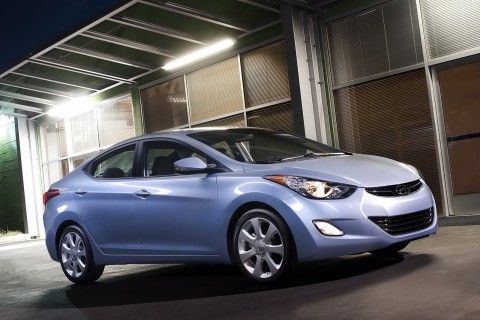
2012 Hyundai Elantra

The Hyundai Elantra is a compact car with handsome styling and nice lines. It has excellent interior space and standard safety equipment.
The current generation Elantra can seat up to five and has very accommodating trunk space. Two trim levels are offered: GLS and Limited. Both use a 148-hp, 1.8-liter four-cylinder engine. A six-speed manual transmission is standard on the GLS trim, while a six-speed automatic with Shifttronic is standard on the Limited trim and available on the GLS. Standard safety features include four-wheel anti-lock disc brakes, electronic stability

control with traction control and six airbags. Available features include a power sunroof, turn signal indicators on exterior mirrors, 17-inch aluminum wheels, heated leather seating surfaces and Bluetooth.
The 2012 Elantra carries over from 2011.


Sunday, August 7, 2011

KTM Prepare New Models to 2014

Image of KTM new model for the next three years uncovered after an American dealers from taking pictures with camera phones in the middle of the presentation.

The photographs showed the model from 2012 until 2014, of which R 690 Enduro and motocross latest for the 2012 model Duke 350, Adventure Super Duke R 1090 and R 1290 as a 2013 model and Moto3 Enduro 350 and 350 for model 2014.


Moto3 350 which is designed fullfairing touted as a modern model that is able to replace older models such as the class 250 cc Suzuki RGV250, Aprilia RS250 and Honda NSR250.

Talk to 350cc engines, KTM seems to want to create your own category after one successful model in the market ie SX-F350.

Adventure R 1090 is prepared to take off the market saturation with a 990cc model, with reinforced Super Duke R 1290 engine which uses all-new V-Twin.

Besides the models mentioned above, there is also an electric motor like a freeride model. KTM wants to try to step far into the future where will be the future, this Austrian manufacturer plans to use off-road engine power.

Sunday, July 31, 2011

BMW X3 xDrive35i

In this 2011 BMW car manufacturer officially launched a new variant was named BMW X3 xDrive35i with six-cylinder inline engine gasoline. This variant is included in the class of SUVs (sports utility vehicle). Meanwhile, another variant is the BMW X3 xDrive20d engined four cylinder in line diesel.
By all appearances, this second generation of the BMW X3 comes with urban-style body design elegant and the view that gagah.BMW X3 xDrive uses a capacity of 3000 cc engine that can generate power to 306 hp at 58.00 rpm and maximum torque of 400 Nm at engine speed between 1200 and 5000 rpm.
While the BMW X3 xDrive20d using turbo four-cylinder diesel engine in line with a capacity of 2,000 cc which is made of aluminum and equipped with common rail direct injection. This machine is capable of spraying power up to 184 hp at 4,000 rpm rotation and a maximum torque of 380 nm in 1750 and 2,750 rpm.

Fresh from the redesign of the exterior and a good stretch, 2011 BMW X3 xDrive35i looks more bold and offer more space for people and goods. Yet deep inside an off-camber switchback mountain, it is to convince you That it's just a tall sports sedan. And no longer hits the contents of your loose to PROVE it.
As before, the standard all-wheel drive ensures That the 2011 BMW X3 xDrive35i earnest climb up the forest road with the first chairlift or the trailhead with ease - even if the most Difficult labor involved only draw Some Sea-Doos or Transporting a distance from Some Banana Republic for road construction.
But the 2011 BMW X3 xDrive35i driving every day cans be annoying, slow throttle response interfere with low-speed character in city driving. The Acura RDX, Audi Q5, Infiniti EX35 and Mercedes-Benz GLK350 all offer a more direct connection to the drivetrain and performance, making it more intuitive.
Given an open road and heads began to roll, but the BMW X3 Gives an exhilarating rush head.

BMW i3 Concept

The BMW i3 Concept is an uncompromisingly sustainable vehicle designed for urban areas. Driven purely by electric power and purpose-built to meet the demands of sustainable and emission-free mobility, it embodies an intelligent form of urban transportation and commuting.
"This automotive concept uses a new architecture which showcases all of its new possibilities and potential. It is the world's first premium electric vehicle." - Andreas Feist, Head of vehicle project BMW i3.
The BMW i3 is a well-resolved all-round concept, with every detail conceived and optimised to fulfil its eventual purpose. Central to its design is the innovative LifeDrive architecture, the key to the BMW i3 Concept's appeal as a light, safe and spacious car. Innovative use of materials and intelligent lightweight design not only enable the i3 Concept to travel long distances on a single charge and provide superb safety in the event of a collision, they also help give the car its excellent driving dynamics. The secure arrangement of the battery in the Drive module gives the vehicle a very low centre of gravity and optimum weight distribution. The electric motor over the rear axle - which generates output of 125 kW/170 hp and impressive torque of 250 Nm (184 lb-ft) from a standstill - and a small turning circle combine to deliver pleasingly crisp driving characteristics and give the driver a very immediate experience of the BMW i3 Concept's lightweight design. The BMW i3 Concept accelerates from 0 to 60 km/h (37 mph) in under four seconds and from rest to 100 km/h (62 mph) in less than eight seconds. The extremely direct sensation at the wheel is expressed in outstanding agility at low speeds and during turning manoeuvres, and makes parking in tricky situations that much easier.


The Life module conjures up a feeling of space inside the car more generous than even the latest conversion vehicles can offer. Select materials lend the open and airy cabin a lounge-like character. The use of renewable raw materials is another defining characteristic of the interior, offering passengers a further means of "experiencing" the sustainability of the vehicle. Elements of the instrument panel and door panelling are visibly made from natural fibres, while the naturally tanned leather of the seats creates a lounge-style ambience. Together, these materials provide an appealing contrast to the clear, "floating" forms of the instrument panel and door elements, and lend the interior a strikingly modern feel. With the drive components located in the Drive module, there is no centre tunnel running through the passenger compartment. This allows the two front and two rear seats to be connected with each other by a continuous seat surface, which allows for ease of entry and exit via the front passenger side of the car and means you can park up close to walls, for example. With four seats, wide-opening opposing "coach" doors, boot capacity of around 200 litres and an additional functional compartment in the front, the BMW i3 Concept is neatly equipped for the demands of everyday use.
However, the electric motor developed by BMW and the optimised lightweight design of the LifeDrive architecture cannot take all the credit for imbuing the car with such efficiency and enabling it to travel such long distances on each charge. Indeed, the ability of the car to recoup energy while on the move and special range-extending functions, such as ECO PRO mode, also add miles to the clock. With ECO PRO mode activated, all the vehicle functions operate with maximum efficiency. For example, the accelerator mapping is tweaked to limit the output summoned when the driver flexes his right foot, and the climate control functions also use as little energy as possible. Added to which, sophisticated aerodynamics and slim, low rolling resistance wheels minimise resistance to the car's forward progress and maximise its range.
Innovative connectivity functions create a seamless connection between the BMW i3 Concept and its customers' lives outside the car. Remote functions accessible via a smartphone enable owners to find their vehicles, flag up nearby charging stations, allow battery charging and preconditioning at the touch of a button and supply information on the current status of the vehicle. Meanwhile, intelligent assistance systems ease the stress on drivers in monotonous city driving situations and allow them to arrive at their destination more safely and in a more relaxed state of mind.

BMW 6-Series Coupe

With the BMW 6-Series Coupe Concept debuting at the 2010 Los Angeles International Auto Show as its backdrop, BMW announced the production-ready BMW 650i Convertible. The new 650i Convertible will go on sale in the Spring of 2011 as a 2012 model for the United States. Final pricing, options, and packages will be announced closer to the on-sale date.

Words like "breathtaking" and "irresistible" punctuate the history of BMW Convertibles. Now, BMW has opened a new chapter in the tradition of open-top cars. The new BMW 650i Convertible fulfils the wishes of the most discerning automotive enthusiast as The Ultimate Driving Machine® with groundbreaking luxury and crisp good looks. In the premium convertible market, the BMW 650i Convertible presents a convincing case with the most advanced chassis technology and most innovative comfort, infotainment and safety features.

A sweeping hood, aft-set passenger compartment, long wheelbase and muscular profile embody the hallmark proportions of a BMW Convertible. The new BMW 650i Convertible combines these features with a classic soft-top roof with flying buttress design. Powerfully contoured surfaces of its lines promise the anticipated BMW driving experience. The luxurious ambience of the interior is highlighted by a driver-oriented cockpit which wraps the front and rear passengers in a feeling of aesthetic security. Nowhere is the high-class functionality of the interior underlined more prominently than in the redesigned freestanding 10.2" Central Display of the standard iDrive control system.

BMW M3 CRT

The BMW M3 CRT (Carbon Racing Technology) embodies a concentrated blend of state-of-the-art development expertise - inspired directly by motor sport - in the areas of drive system and chassis technology and intelligent lightweight design. It also represents the worldwide debut of a new production process for carbon-fibre reinforced plastic (CFRP) components in the automotive industry. This process allows CFRP to be introduced widely in the construction of the high-performance BMW M3 Saloon-based sports car

created by the BMW M GmbH factory. And that helps it achieve a weight-to-power ratio of 3.5 kilograms per horsepower. A V8 engine with customary M high-revving characteristics and maximum output of 331 kW/450 hp accelerates the BMW M3 CRT from 0 to 100 km/h in just 4.4 seconds.
The BMW M3 CRT will be produced by the BMW M GmbH factory in a limited run of 67 units. Following in the tyre tracks of the BMW M3 GTS - of which 135 examples were produced - this is the second small-series, high-performance M3 off-shoot to be bred for the race track but registered for the road. The exclusive character of the Saloon is emphasised by bespoke lightweight design components manufactured as part of an innovative production process. The bonnet of the BMW M3 CRT and the bucket seats for the driver and front passenger are made from a cellular carbon honeycomb, which is produced in a globally unique process pioneered for the manufacture of body components for the BMW i3 and BMW i8 models.


These new models - due to enter volume production in 2013 and equipped with innovative electric and BMW ActiveHybrid drive system technology - will feature a body consisting entirely of CFRP in the passenger cell area. In a new development, the production process introduced for this purpose enables the cuttings left behind in the construction of the body to be reprocessed. The basic material (made up of carbon fibre thread) can now be woven into CFRP mats of any size before being impregnated with synthetic resin and hardened in a similar way to the material used in the body of the BMW i3 and BMW i8. For the BMW M3 CRT this allows the creation of a bonnet made from two CFRP mouldings encasing an aramid honeycomb structure. This construction imbues the bonnet with the strength of a conventional steel equivalent, but at roughly a quarter of its weight. The weight saving over the aluminium bonnet of the standard BMW M3 Saloon is around 50 per cent.
The material produced through this innovative manufacturing technology is also used for the car's bucket seats. Here, the CFRP layers are wrapped around a recycled-paper honeycomb, with a carbon layer made using conventional production technology added to visible areas. CFRP is also used to make both the rear spoiler of the BMW M3 CRT and an air-channelling element integrated into its front apron.
This innovative manufacturing process opens up considerable potential for increased use of CFRP in series-produced cars as a means of lowering weight. The BMW Group is leading the way in this area of automotive construction, while BMW M GmbH can call on extensive racing expertise when it comes to intelligent lightweight design. The BMW M3 CRT is the latest in a fine tradition of highly exclusive high-performance sports cars optimised with the help of lightweight design. This lineage stretches back to the BMW 3.0 CSL of the 1970s and reached another high point in 2002 with the BMW M3 CSL. BMW M GmbH also broke new ground with the use of CFRP in series-produced vehicles; like the BMW M6 produced up to 2010, the current BMW M3 Coupé comes as standard with a roof made from carbon-fibre reinforced plastic.
Significant weight reduction despite generous standard equipment.
The low-weight construction of the BMW M3 CRT is enhanced by sound-proofing configured specially for the new variant and a sports exhaust system with an extremely lightweight titanium muffler. Also unique to the CRT are the two individual rear seats, which take their cues from the lateral support-enhancing contours of the front seats.
Included in the standard specification of the BMW M3 CRT are the M double-clutch transmission with Drivelogic, Navigation system Professional, BMW Individual High End audio system, a light, exterior mirror and luggage area package, an alarm system and Park Distance Control with sensors at the front and rear of the car. Despite this extremely generous selection of standard kit, its DIN unladen weight of 1,580 kg undercuts that of the standard BMW M3 Saloon by around 45 kg. When you take into account the equipment on board the weight saving is more like 70 kg. Added to which, cleverly reducing the load at the front of the car raises the proportion of the car's weight over the rear axle to 48.4 per cent, which has an extremely positive effect on agility.
High-revving V8 engine with extra power; M DCT Drivelogic.
Under the CFRP bonnet of the BMW M3 CRT lies a variant of the V8 engine developed exclusively for the BMW M3 with further increased displacement, output and maximum torque. The high-revving unit provides the linear power delivery you expect from an M car and a highly responsive performance profile honed by the demands of the race track. Tuned for the BMW M3 GTS, the eight-cylinder engine develops 331 kW/450 hp from its 4,360 cc displacement. Maximum output is reached at 8,300 rpm, and the driver will find peak torque of 440 Newton metres on tap at 3,750 rpm. Helping to give the engine its intoxicating performance is wizardry derived directly from motor sport, including a bedplate crankcase construction in a special aluminium-silicon alloy, individual throttle butterflies, a knock control system with ion current technology and a dynamically-optimised wet sump oil supply.
Transferring the engine's power to the rear wheels is the M double-clutch transmission with Drivelogic developed for the BMW M3. The seven-speed M DCT Drivelogic unit also works according to a principle developed in motor sport, allowing an uninterrupted flow of power through gear changes to deliver extremely dynamic acceleration. Its shift characteristics have been tuned specially for the engine powering the BMW M3 CRT. Shift paddles on the steering wheel allow the driver to change gear manually with optimum ergonomics. And a Launch Control function is on hand to generate maximum acceleration off the start line.
Special chassis construction with race-bred technology.
Expertise from race competition also makes its presence felt in the chassis technology of the BMW M3 CRT. The BMW M3 Saloon's front and rear axle construction has been enhanced by a rigid rear axle subframe and coilover suspension whose dampers are individually adjustable in their compression and rebound. The six-piston, fixed-calliper high-performance brakes of the BMW M3 CRT boast a low-weight compound construction. The vented brake discs measure 378 x 32 millimetres at the front axle and 380 x 28 millimetres at the rear. The new M3 variant also uses Stahlflex brake lines and model-specific comfort brake pads.
The specially tuned DSC (Dynamic Stability Control) system - including ABS and M Dynamic Mode (MDM) - responds to both the greater dynamic potential of the BMW M3 CRT and its optimised axle load distribution. Meanwhile, the 245/35 R 19 front tyres and 265/35 R 19 rears (fitted on 19-inch M light-alloy wheels in Y-spoke design) ensure the engine's acceleration and braking power is transferred to the road with maximum impact. The electronic engine management of the BMW M3 CRT caps its top speed at 290 km/h.
The exclusive Frozen Polar Silver metallic exterior paint shade in combination with Melbourne Red metallic applications and special treatment for the BMW kidney grille also help to set the BMW M3 CRT apart from the standard M3. Inside, the Saloon comes with likewise exclusive door sill strips, door panels and trim strips in aluminium grain structure. Completing the distinctive ambience inside the high-performance Saloon are the Alcantara-covered M steering wheel, which has an M Drive button allowing the driver to call up his preferred set-up instantly, and special Sakhir Orange and Black bi-colour covers for the front and individual rear seats.

Tuesday, July 19, 2011

Chevrolet Camaro ZL1

The 2012 Chevrolet Camaro ZL1 debuted at the 2011 Chicago Auto Show. It is the highest-performing Camaro and the most technically advanced car ever developed in its class. The new ZL1 continues the momentum of Camaro, propelling it into an entirely new realm of leading-edge performance technology. It is planned to launch at the beginning of 2012.
Motivated by a supercharged V-8 engine producing an estimated 550 horsepower (410 kW), the Camaro ZL1 will be the fastest Camaro ever offered by Chevrolet. And more than just power, the ZL1 features technologically advanced and highly developed chassis and suspension systems that help it deliver balanced, track-ready handling and braking power to complement its high engine output. Rigorous development of the ZL1 is ongoing, and official estimates of the car’s capabilities will be released later in 2011, as testing nears completion.
“Camaro ZL1 is about high-tech performance and design, and is a type of car no one has ever brought to this segment previously,” said Rick Scheidt, vice president of Chevrolet marketing. “It’s the most technically advanced Camaro ever, so we’ve chosen a name from the most elite and exclusive Camaro in history.”
The ZL1 name is derived from the all-aluminum racing engine of the same name, which was developed in the late 1960s and installed into a handful of regular-production 1969 Camaros. Only 69 were built with the engine, but they’ve achieved mythical status among enthusiasts, as they represented the pinnacle in Camaro performance – until now. The 2012 ZL1 model is designed to be a major leap forward for the Camaro, bringing a new level of performance capability to the segment.

The central goal of the car’s development was creating something new – a Camaro intended to reach optimal lap times on top road-racing circuits and excellent driving dynamics on the street. To achieve that goal, engineers evolved many of the existing Camaro’s systems, as well as incorporated new technologies such as electric power steering and Magnetic Ride Control, the world’s fastest-reacting suspension system.
Camaro ZL1’s design communicates and supports its performance mission. Rather than using decorative elements, ZL1 is visually differentiated from other current Camaro models with elements vital to the car’s elevated capabilities.
“Everything about the ZL1’s design is directly related to its technology and serious performance, especially aerodynamics,” said Ed Welburn, vice president, Global Design. “Our designers’ goal was to execute that function-oriented design with beautifully sculpted forms, creating an imposing, powerful persona. Function becomes the aesthetic. The intent is a car that delivers on the attitude it projects.”
Major elements of the ZL1’s design are a new front fascia and hood with air extractors, designed in tandem to create aerodynamic downforce to aid handling. The car’s hood includes a signature center section constructed of carbon fiber and rendered in satin black finish. New rocker panels, wide tires, 20-inch wheels and exhaust tips portray the car’s handling and power.
The ZL1 badge appears on the grille, hood and the brake calipers, all key areas portraying the technology within.
Tech overview.
Supporting the dynamic track and street performance of the ZL1 is the LSA 6.2L supercharged engine, which will produce an estimated 550 horsepower (410kW) and 550 lb.-ft. of torque (677 Nm), with specific features for the Camaro. Built on GM’s legendary all-aluminum, small-block V-8 architecture, the LSA features an intercooled supercharger system, premium heat-resistant aluminum-alloy cylinder heads and other details designed to ensure its exceptional performance is delivered with smoothness and refinement. Components and design elements that contribute to the LSA’s performance include:
• Balanced, lightweight reciprocating assembly
• High-strength hypereutectic pistons
• Sixth-generation Eaton supercharger with four-lobe rotors
• Piston oil squirters.
Because the Camaro ZL1 uses electric power steering, the engine does not incorporate a conventional hydraulic power steering pump on its accessory drive system. This enhances performance, because no engine power is used to turn a steering pump pulley.
Camaro ZL1 is a complete high-performance car, not just a Camaro with more power. Key technical highlights include:
Transmission – The high-performance Tremec TR-6060 six-speed manual is matched with the LSA engine. It is the “MG9” version of the transmission, with a higher torque capacity. It is used with a dual-mass flywheel and twin-disc clutch for easy operation and shift smoothness. A new, shorter-throw shifter actuates the gear changes.
Exhaust – ZL1 is equipped with a dual-mode exhaust system, which alters the sound level and character in response to engine rpm. First used on the legendary Corvette, and specifically tuned for Camaro ZL1, the dual-mode exhaust will give the car a signature sound.
Drivetrain – It is revised with a stronger driveshaft and rear axle system, featuring a larger and stronger cast iron differential housing, stronger axles and heavy-duty limited-slip differential. This patent-pending system is designed to ensure that ZL1’s tremendous power is delivered smoothly to the ground.
Suspension – The suspension features completely revised tuning and the inclusion of segment-exclusive Magnetic Ride Control. ZL1’s Magnetic Ride system will include driver selectable modes (Tour and Sport) tailored for the preferred style of driving. It uses advanced magneto-rheological science to produce shock damping with the highest level of precision, enabling body control optimized for excellent performance in everyday driving as well as track situations. This technology appears on only a small roster of some of the world’s finest performance cars. Other chassis elements are redesigned to support the car’s high-performance limits. Rear stabilizer bars have drop links repositioned outboard of the control arms. This makes the bars more effective in controlling body roll in turns, with crisp response to driver commands.
Brakes and Steering – Camaro ZL1 features an advanced track-capable braking system, developed in conjunction with experts from Brembo. The large 14.6-inch (370 mm) two-piece front rotors have six-piston calipers; the 14.4-inch (365 mm) rear rotors have four-piston calipers. ZL1 marks the entry of a new electric power steering system to Camaro. It is being developed to ensure precise control and feedback to the driver, with greater variability of effort for high-performance driving.
Exterior – ZL1’s signature from the front is the redesigned fascia and aluminum hood with a raised, carbon fiber insert. The fascia includes a front splitter and new vertical fog lamps. The fog lamp area includes air intakes designed for brake cooling. The hood features front-mounted air extractors that direct air precisely over the car. Visually, this center section, in satin black carbon fiber, communicates the car’s high-performance intent as a visual contrast to the car’s exterior color. Functionally, the air extractor is a key in connecting airflow closely to the bodywork, creating aerodynamic downforce. The carbon fiber center section reduces the mass of the hood. High-intensity discharge (HID) headlamps and fog lamps are standard. The rear of the car includes a diffuser and spoiler, also functional elements that enhance the car’s aerodynamics.
Wheels and Tires – New-design, 20-inch forged aluminum wheels, which are lighter than the 20-inch wheels used on the Camaro SS, are used with new Goodyear Supercar F2 ties developed specifically for the ZL1.
Interior – ZL1 is tailored for high-performance driving. The front seats feature microfiber suede inserts. Other enhancements include a redesigned steering wheel, alloy pedals, Head-Up Display with unique performance readouts and the “four-pack” auxiliary gauge system featuring a boost readout.
Production details.
All of the Camaro exterior colors will be offered with the ZL1, but black is the only interior color. The unique exterior features are complemented with a black center section on the hood. Inside, the Camaro ZL1 has heated leather seats with microfiber inserts and ZL1 logos embroidered on the front headrests. Microfiber suede is repeated as an accent on the instrument panel, adding a richer look to the interior. The ZL1 will include the same content as the current 2SS package and include the following new or unique features:
• Six-way power driver and passenger seats
• Unique instrument panel and door panel inserts; and ZL1-logo sill plates
• Steering wheel audio controls with Bluetooth capability
• Wireless PDIM and USB-port
• Boston Acoustics premium audio system
• Rear parking assist
• Rear camera system (displayed in the inside rearview mirror).
Engineers have already driven Camaro ZL1 prototypes extensively at demanding road courses in the U.S. and Germany, with final testing being completed through the balance of 2011.